The Greeks Had a Word For It by Andrew Taylor
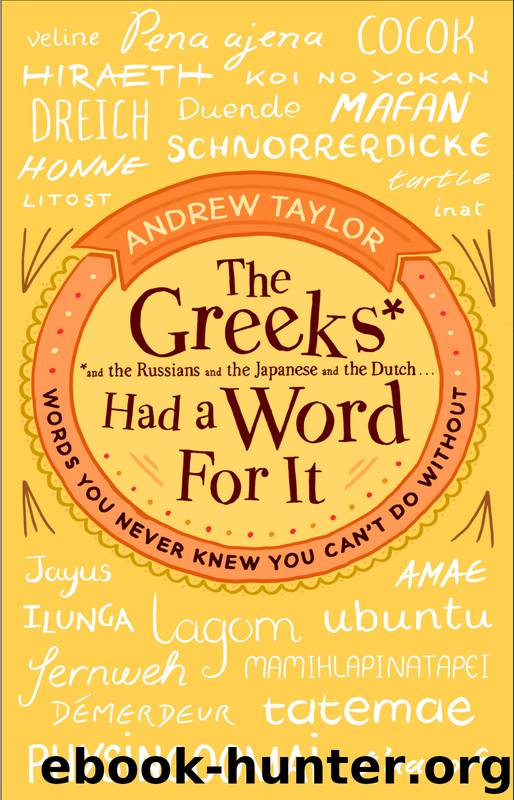
Author:Andrew Taylor
Language: eng
Format: epub
ISBN: 9781473526372
Publisher: Transworld
Honne & Tatemae
(Japanese)
A person’s private and public faces – how we really feel, and the mask we show to the world
ENGLISH LIKES TO think of itself as a bluff, honest, John Bull of a language that says what it means and means what it says. Words that suggest that we may tell lies or misrepresent ourselves – ‘hypocritical’, for instance, ‘insincere’, ‘double-dealing’ or ‘duplicitous’ – all leave a sour taste in the mouth. Who wants to be thought a hypocrite?
And yet it doesn’t always reflect the way that we behave. We all occasionally sacrifice the harsh truth in favour of the kinder, gentler, or just the easier thing to say.
Pollsters’ surveys report that voters want one thing – high public spending, perhaps, even with the taxes to pay for it – but they regularly go into the privacy of the polling booth to vote for something completely different. Honesty and straightforwardness sound a much less attractive option to the man faced with the classic question, ‘Does my bum look big in this?’ ‘Delicious,’ we will say to a waiter, before smuggling pieces of inedible gristle into a paper napkin to slip into our pockets.
We have no word to suggest that there may be perfectly honourable reasons for being less than completely truthful – privacy perhaps, or a sense of decency, or an unwillingness to cause hurt. Kindness is a virtue just as much as honesty.
Japanese is possibly the only language with words to describe such behaviour. Honne (HON-NEH) is the way you really feel, the thoughts and feelings that you will only express to your closest confidants. For everyone else, there is tatemae (tat-eh-MY-eh), the face that we show to the public – respectable, polite, cool and revealing nothing about our true feelings. The Japanese business contact to whom you explain your proposals may nod and smile and say ‘Hai, hai,’ – but whatever the Japanese phrasebook may say, the words do not really mean ‘Yes, yes.’ They mean simply, ‘I hear you.’
‘We must do lunch,’ they may say, brightly, without intending any such thing.
Honne is to be kept carefully guarded. It might include your deepest dreams and wishes, your personal opinions and, crucially, your real emotions. It would take a long time and a lot of building of trust before foreigners – gaijin or gaikokujin, which literally means ‘outsider people’ – would be likely to share honne.
Learning to understand this difference between honne and tatemae, to adjust your speech to fit the person you are talking to, is one of the key lessons of social etiquette for Japanese children. The distinction runs through Japanese society, from the behaviour of politicians and government officials to relations between business contacts to daily social interactions.
It’s important, too, to recognize how you are being spoken to. An invitation for a meal, for instance, might be tatemae, a purely formal mark of courtesy that is not meant to be taken up. English speakers do much the same thing – ‘We must do lunch,’ they
Download
This site does not store any files on its server. We only index and link to content provided by other sites. Please contact the content providers to delete copyright contents if any and email us, we'll remove relevant links or contents immediately.
Still Foolin’ ’Em by Billy Crystal(36453)
Spell It Out by David Crystal(36213)
The Great Music City by Andrea Baker(33269)
Professional Troublemaker by Luvvie Ajayi Jones(29741)
Trainspotting by Irvine Welsh(21943)
Call Me by Your Name by André Aciman(20693)
The Secret History by Donna Tartt(19436)
We're Going to Need More Wine by Gabrielle Union(19155)
Cat's cradle by Kurt Vonnegut(15525)
Ready Player One by Cline Ernest(15109)
Molly's Game by Molly Bloom(14241)
Bombshells: Glamour Girls of a Lifetime by Sullivan Steve(14206)
The Goal (Off-Campus #4) by Elle Kennedy(13939)
Leonardo da Vinci by Walter Isaacson(13471)
4 3 2 1: A Novel by Paul Auster(12596)
The Social Justice Warrior Handbook by Lisa De Pasquale(12283)
The Break by Marian Keyes(9466)
Crazy Rich Asians by Kevin Kwan(9400)
The remains of the day by Kazuo Ishiguro(9189)
